Pallet conveyor system

Pallet conveyor systems

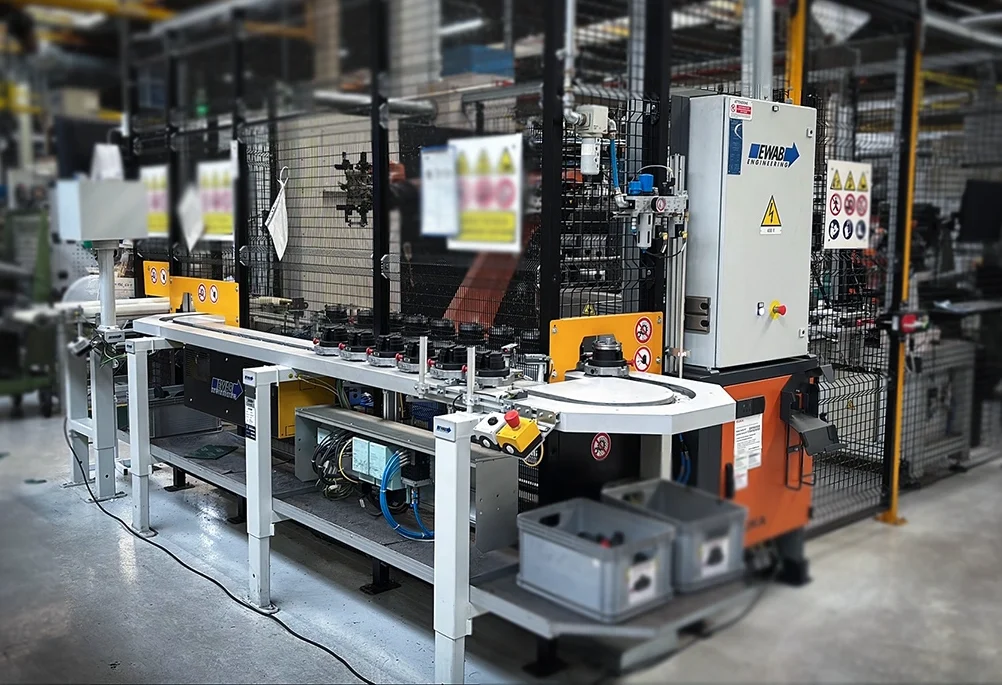
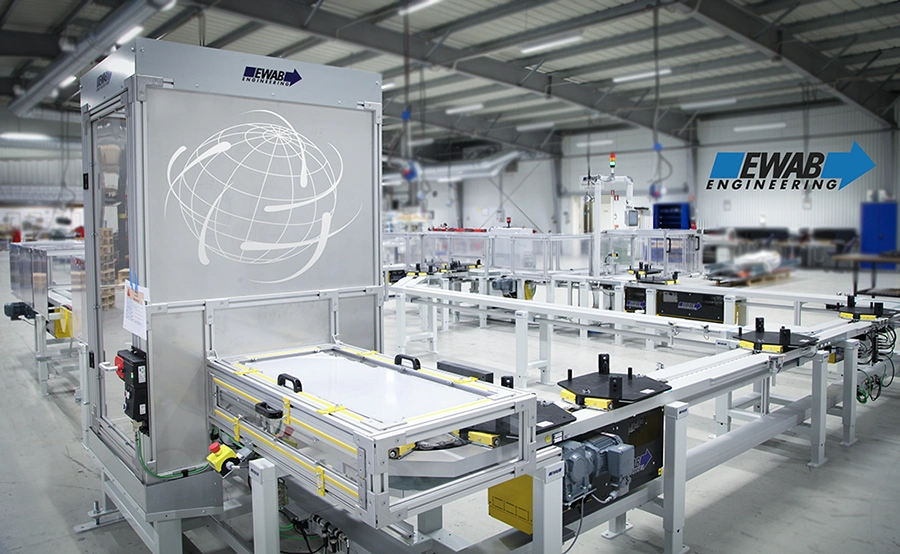
EWAB’s pallet conveyor systems—also referred to as workpiece carrier systems—are engineered to enable controlled, material flow of parts between manufacturing and assembly processes. Based on modular design principles and decades of application experience, these systems ensure stable, repeatable, and efficient transport of components throughout production lines.

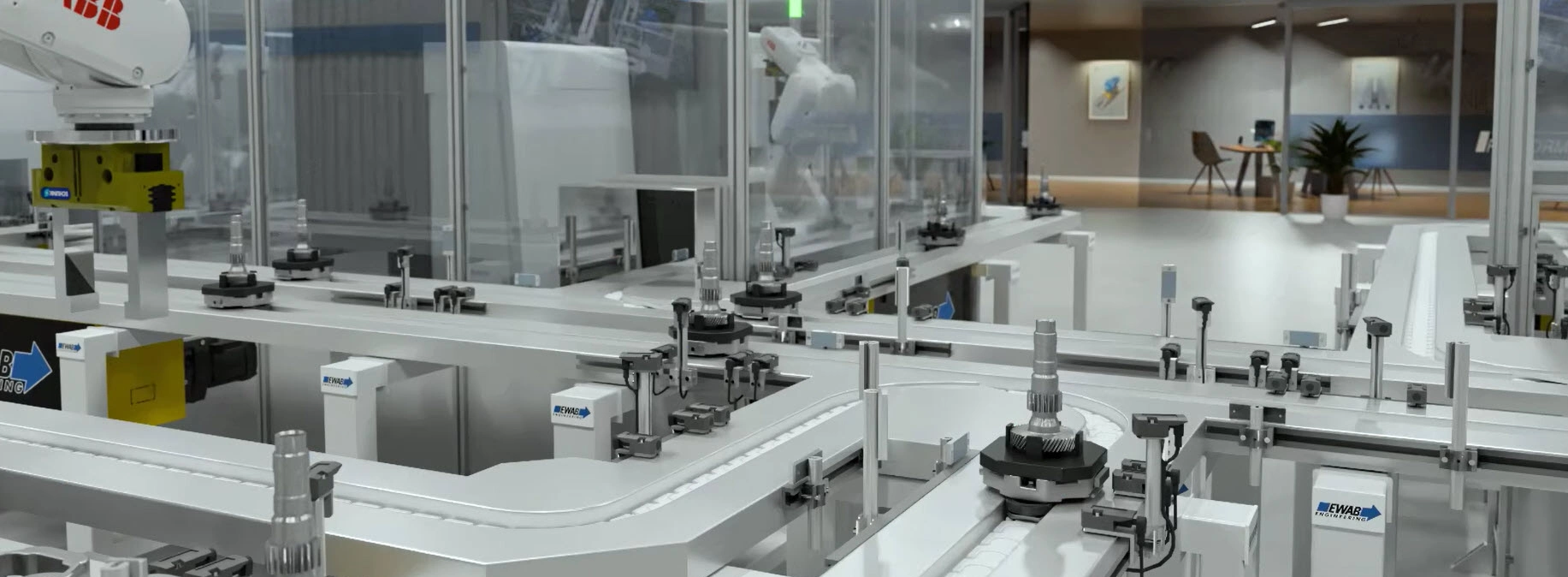
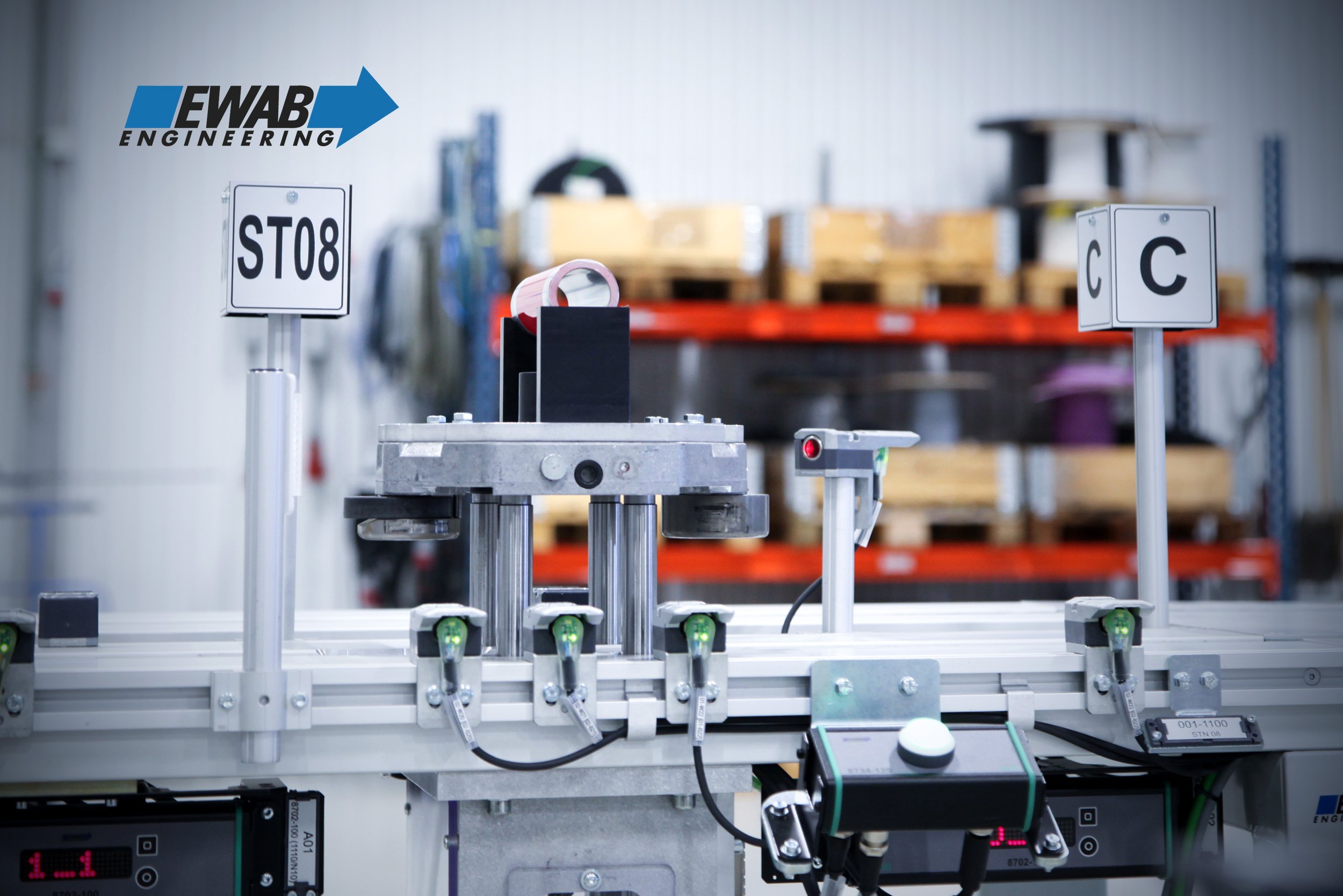
Basically, the core of the system is a friction-driven plastic chain that transports workpiece carriers with high reliability and precision. This proven principle enables smooth accumulation, controlled buffering, and consistent material flow between machines.

EWAB CS200 carrier system
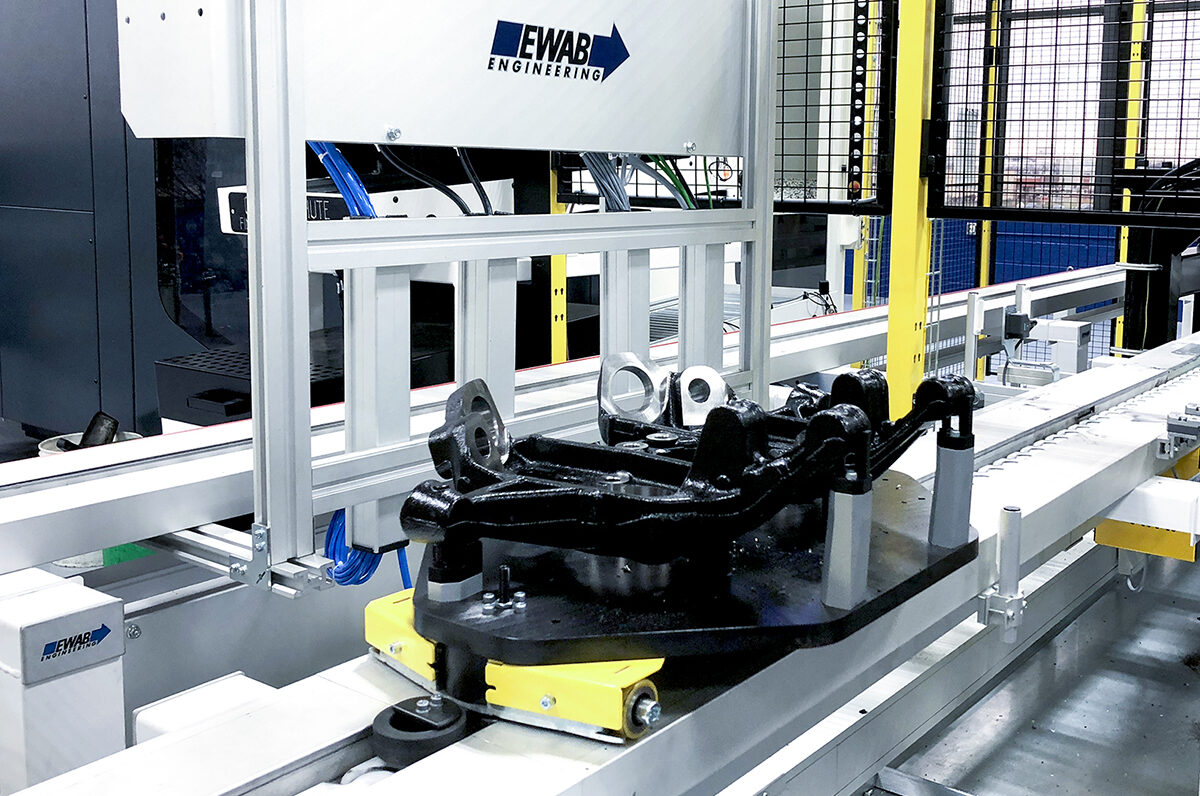
PS800 pallet

Built for flexible production

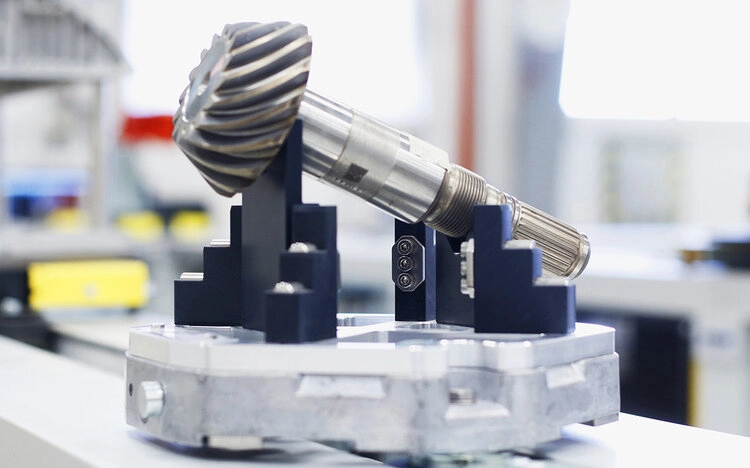
Each pallet and carrier is designed to support accurate positioning, controlled pressure, and repeatable handling. Ensuring that parts move securely through every stage of production. Furthermore, integrated sensors, stops, and buffer functions enable self-regulating flow and seamless interaction with upstream and downstream equipment.

The pallet conveyor systems are built for flexible production—from standalone cells to fully automated multi-process lines. Therefore, the modular architecture allows systems to be configured and expanded over time, supporting both high-volume production and mixed-model manufacturing with varying cycle times and routing requirements.

Flexible flow line by EWAB

Flexible flow lines

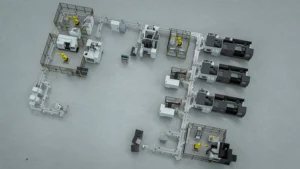
A multi-process system with dynamic routing, where pallets can move between any operations via highways and satellite stations. Dynamic buffers balance flow, while RFID ensures full part traceability—enabling efficient mixed-model production with maximum throughput.

Material flow that connect machines

Continuous flow lines

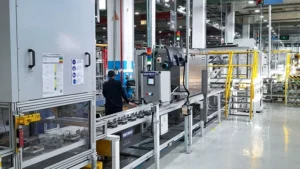
Sequential pallet conveyor system with guided flow through serial and parallel operations. Balanced capacity with integrated buffers ensures stable throughput, while RFID enables full part traceability.

Machine buffer loops

Machine buffer loops

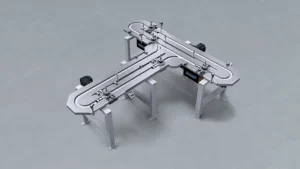
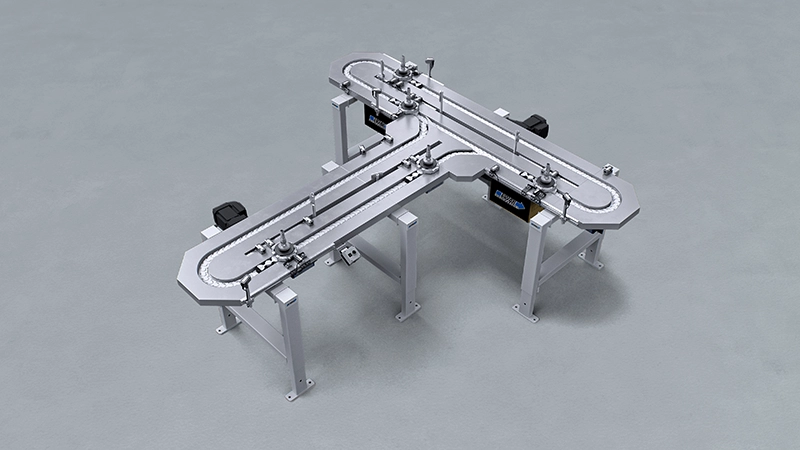
Compact stand-alone pallet conveyor systems for buffering around single operations. Modular design with flexible configurations ensures stable machine utilization in a small footprint.

Benefits with pallet conveyor systems

Did you know that the EWAB pallet conveyor systems are designed to streamline material flow and create stable, high-performance production environments? This is done, by automating the movement, positioning, and buffering of parts between operations.

Precise routing and positioning ensure consistent handling of components, while integrated buffering and re-circulation functions balance the flow between operations. This reduces disturbances, prevents bottlenecks, and supports continuous production with high system availability.

So, if you want result and measurable improvement in manufacturing performance, you are at the right place.

EWAB system solutions have been deployed in more than 25 countries.


– Higher throughput and utilization through optimized flow and balanced operation. Real cases were EWAB doubled the throughput

– Reduced work-in-progress (WIP) by enabling controlled accumulation and just-in-time production

– Improved ergonomics and safety by minimizing manual handling and stabilizing workflows

– Increased quality and traceability through accurate positioning and integrated RFID tracking

Up-time of 99.9%


Additionally, the systems integrate seamlessly with robotic cells and other automation technologies, forming a reliable backbone for modern manufacturing. As a matter of fact, with proven installations across industries, EWAB pallet conveyor systems provide a solid foundation for efficient, flexible, and data-driven production. In this case, developed from decades of conveyor automation projects in automotive and industrial manufacturing.
Want to learn more?

Download and read our guides.

In our Agile production seminars you will get a better understanding how a proper workpiece flow in production will help to achieve operational excellence

Material flow line
Products in machining
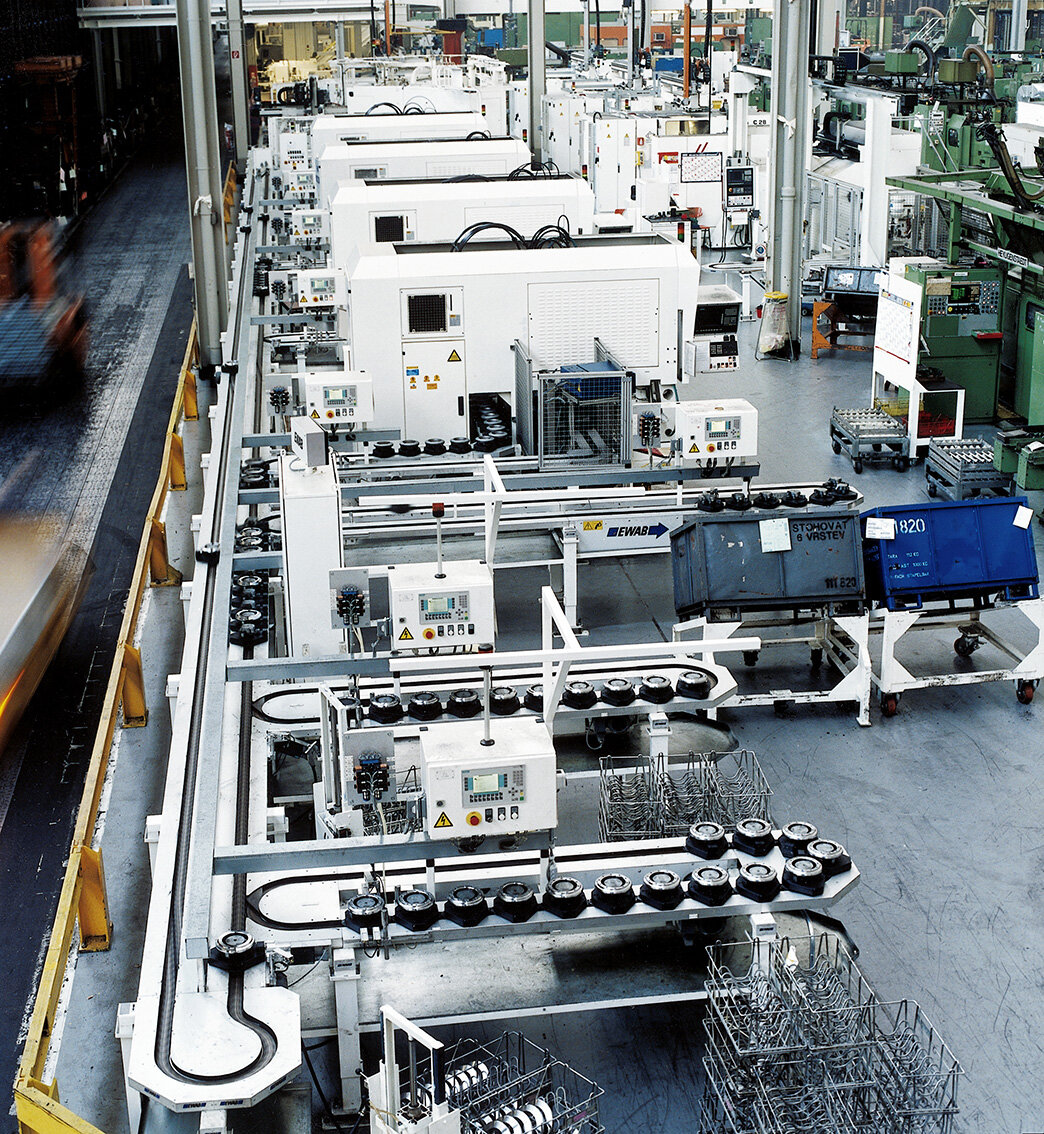
Installed at customer in Germany - Automotive machining line

Flexible flow lines

Multi-process flow system

A multi-process flow system where parts are automatically distributed between operations. In a flexible flow line, pallets can be dynamically routed from any station to any other, enabling full system-wide routing flexibility. The layout is typically structured around main conveyor highways and satellite stations, allowing efficient distribution and decoupling of processes.

The pallet conveyor system utilizes dynamic buffering to balance flow between operations and maintains stable machine utilization. Further, the integrated RFID enables part identification and traceability throughout the process, supporting sequencing, quality control, and data-driven production management.

This architecture allows multiple product variants to run in parallel and supports true mixed-model production. As a result, flexible flow lines are a highly effective solution for maximizing throughput while maintaining production flexibility and traceability.

Mostly used with PS800 & PS810 systems.

Continuous flow lines

Pallet conveyor for serial & parallel operations

A pallet conveyor solution designed for sequential production with serial and parallel operations. This means, the pallet conveyor system automatically distributes material between all stations, ensuring a controlled and predictable flow throughout the line.

At this point, operations are arranged in a defined sequence, with flow typically guided rather than dynamically routed. This enables stable throughput and makes continuous flow lines well suited for high-volume production with balanced cycle times.

To maintain performance and prevent bottlenecks, buffers are implemented between operations, allowing controlled accumulation and decoupling of processes. At the same time, the system is modular and reconfigurable, supporting adaptation to changing production requirements over time.

Lastly, integrated RFID enables seamless part identification and full traceability across the entire process. This is supporting quality control and production transparency.

Your parts can have a weight up to 400kg / 900 lbs.

CS200, CS900,  PS800 & PS810 systems.

EWAB CS200 carrier
Installed at customer in USA
Continues flow line by EWAB Engineering
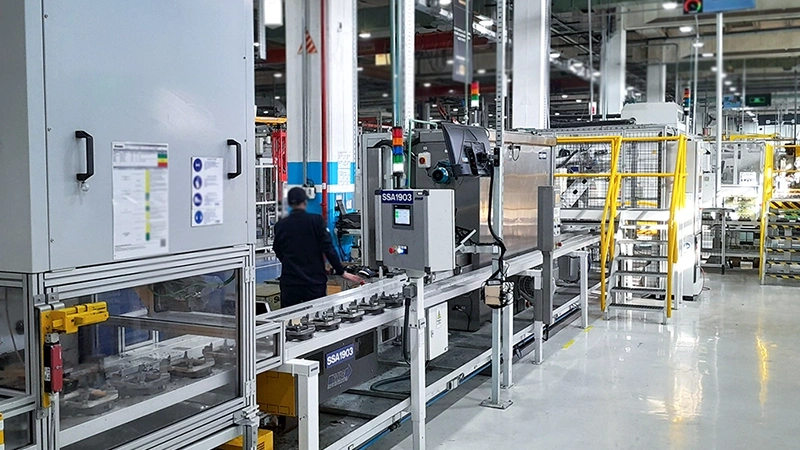
Power train production at customer in Argentina

Machine buffer loops

Single cell operation

A pallet conveyor solution designed as a stand-alone unit, typically used to support and optimize a single operation. Machine buffer loops enable controlled accumulation of parts before and after a process, ensuring consistent machine utilization and minimizing interruptions.

The system is often integrated around individual machines to provide dedicated buffering, decoupling the operation from upstream and downstream variations. For that reason, this makes it a reliable solution for stabilizing cycle times and handling temporary imbalances in production flow.

Machine buffer loops are highly modular and available in various sizes and configurations, allowing adaptation to different layouts, part geometries, and capacity requirements. Despite their functionality, they are designed with a compact footprint, making them suitable for space-constrained environments.

You can add-on a wide range functions—such as stops, sensors, and handling stations. 

Customers are OEM´s and Tier 1 & 2 suppliers.

Additional Equipment

Customise the solution for your needs – a wide range of additional equipment can be added to support specific process requirements. As well as improve accuracy, and enable higher levels of automation and traceability.

In fact, these features are fully integrated into the conveyor system and configured based on the application, part characteristics, and production objectives.

Traceability and data integration
  • RFID systems enable complete traceability of all manufactured components, supporting identification, tracking, and data exchange throughout the production process.
  • Code readers and DMC readers allow scanning of barcodes or data matrix codes, including multiple codes per part, ensuring correct identification and process control.
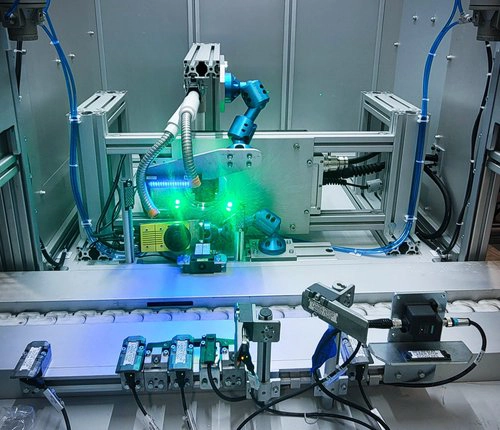
  • Laser marking stations provide permanent, high-quality labeling for part traceability and lifecycle tracking.
  • Digital services connect the system to higher-level platforms, enabling data collection, monitoring, and production insights
 
Positioning and handling functions
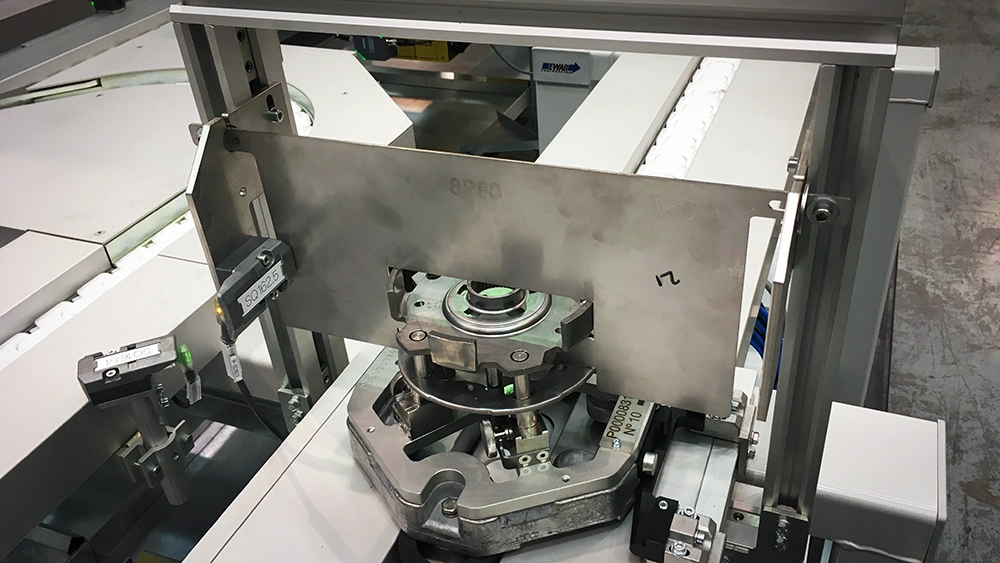
  • Lift stations ensure correct positioning of parts for machine loading and unloading.
  • Shot-pin stations provide additional fixation of pallets to achieve high positioning accuracy during operations.
  • Pallet turners and part turners enable reorientation of pallets or workpieces before or after processing.
  • Track lifts allow the conveyor track to move between different levels, supporting compact and multi-level layouts.
 
System access and ergonomics
  • Swing gates provide safe and efficient access through the conveyor system for operators, cleaning, and maintenance activities.
  • Loading devices, such as robots, gantries, portals, and pick-and-place systems, automate material handling and integrate seamlessly with the conveyor system.
 
Process integration and quality
  • Additional stations, such as washing, SPC, quality inspection and laser marking, can be integrated directly into the material flow.
  • Poka-Yoke solutions are implemented to prevent errors and ensure correct part handling and process execution.
 

More pictures can be found in the the virtual tour.

Inside the laser marking station
Inside a customized laser marking station
EWAB lift station
Lift station for a PS800 system
Poka yoka
Poka-Yoke
FAQ
How are pallets tracked?

Each pallet can be equipped with RFID tags that log product ID, process status, timestamps, and quality data. The system enables full traceability and real-time monitoring.

Moreover, traceability in a pallet conveyor system involves assigning unique identifiers. Like collecting, and integrating data at various stages of production. Altogether, using this information for real-time monitoring, quality control, compliance, and supply chain visibility.

Implementing an effective traceability system is crucial for industries. Because, that require precision, accountability, and compliance with regulatory standards.

In many of EWAB projects the customer wants us to implement RFID traceability for their products.

Overall, RFID traceability in the manufacturing industry contributes to operational efficiency and improved quality control. It´s also compliance with regulations, and better overall visibility and control over the production process

EWAB system solutions are present globally, utilized by OEMs and Tier 1 & 2 suppliers.

Throughout our history, we’ve collaborated with established companies producing components for industrial goods. Our pallet conveyor systems are designed for automotive, electronics, defence equipment, trucks, industrial components and bearings.

With our other conveyor types we have a broader market with industrial equipment, food, beverage, pharma and machine tending solutions.

In an EWAB pallet conveyor system, buffering works by temporarily storing pallets between production stations to balance differences in cycle times and prevent bottlenecks. The system automatically controls pallet flow using sensors, routing logic, and configurable accumulation zones. Especially, ensuring machines continue operating even if upstream or downstream processes slow down or stop temporarily.

This improves throughput, reduces machine starvation, and stabilizes overall production flow.

Yes, EWAB conveyor systems can integrate with most types of robots, cobots, gantries and portal systems. This is done through standardized mechanical and control interfaces.

When a pallet carrier reaches a designated stop position. The robot or loading system can pick the workpiece directly from the conveyor.

Depending on the application and positioning requirements. Lift stations or shot-pin positioning may be used to ensure precise and repeatable alignment during loading and unloading operations.

EWAB has extensive expertise in integrating robotic machine loading solutions for machining, assembly, and material handling applications.

EWAB pallet conveyor systems can handle pallet loads of up to 400 kg. This is depending on the system configuration and application requirements.

It is also possible to use carriers with multiple parts or product variants on the same pallet. Whenever, needed for flexible manufacturing flows.

Read more about EWAB workpiece carriers and pallet solutions here.

EWAB pallet conveyor systems are controlled through PLC-based automation systems. We are using industrial control platforms such as Allen-Bradley and Siemens.

The PLC manages all core functions. Like, including pallet routing, accumulation logic, positioning, and communication with connected machines and robotic systems.

The control system is typically integrated with higher-level factory systems (such as MES/ERP). We uses sensor feedback along the conveyor to ensure precise tracking, synchronization, and flow control across the entire production line.

Yes, several products in mixed flows are possible. That means that you can run operations with different families. (Different parts on the same line).

The number of pallets is primarily determined by the required production flow stability rather than a fixed rule or standard configuration.

Key factors include the cycle time variation between machines. But also the desired buffer capacity between operations, and the overall takt time of the production line.

Systems with higher variability or longer cycle time  require a larger buffer to prevent machine starvation and maintain continuous operation.

Additional factors such as the number of parallel processes, routing complexity, product mix, and expected downtime scenarios also influence the total pallet count. In practice, the final number of pallets is defined during system design to ensure a stable balance between work-in-progress (WIP), throughput, and available floor space.

One interesting observation from real-world projects is that customers often request more pallets than technically required. Typically to create large buffers in front of machines. However, beyond the calculated optimal buffer level, additional pallets generally do not increase output. They simply result in more workpieces waiting idle for the next available operation.

EWAB pallet conveyor systems are designed with modularity as a core principle. If you want they can be expanded or reconfigured after installation to match changing production requirements.

Additional conveyor sections, buffer zones, workstations, or interfaces (such as robots or machines) can typically be integrated into an existing system. The control system is also designed to be scalable. This allows new routing logic, stations, and production flows to be added without replacing the entire installation.

Reconfiguration is usually driven by changes in product mix, increased capacity demands, or layout adjustments in the factory. While mechanical modifications depend on the existing layout.

In an EWAB pallet conveyor system, a machine stop is handled through controlled buffering and PLC-based flow management. This prevent disruption of the overall production flow.

If a machine stops, pallets intended for that station are automatically held in buffer zones. The rest of the system continues operating where capacity is available. This isolates the disturbance locally and prevents the entire line from stopping, and allowing other machines and processes to keep running.

Once the machine is available again, pallets are released in a controlled sequence to restore balanced flow and maintain system stability.

In practice, flexible flow line concepts are often designed with machine failures and downtime as a normal condition, rather than an exception. When parallel processes and autonomous routing are used. The flexible flow systems can recover lost production more quickly and are less dependent on strict sequential operation. This typically results in higher overall throughput and improved ROI compared to rigid continuous-flow designs.

However, continuous flow systems are sometimes chosen because they are easier to calculate and model at an early stage. The trade-off is that such systems become more dependent on every individual machine operating without interruption, often requiring higher availability across the entire line to maintain expected output levels.